
Models of Professional Development
According to the North Central Regional Educational Laboratory NCREL (2007) there are five frameworks they propose to aid educational leaders in implementing a strategic plan. These frameworks may be followed individually or interdependently to reach the goals of improving professional development programs that lead to systemic change and result in high quality educational organizations.
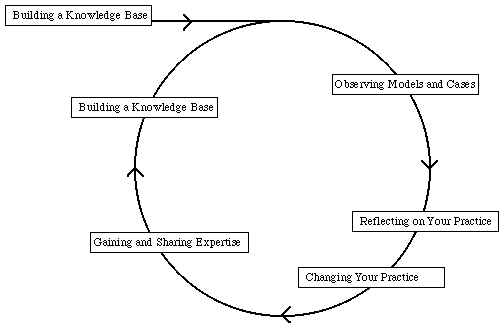
The first framework involves phases of a professional development plan. The first stage involves building a knowledge base; this phase involves helping shareholders in the organization to acquire new knowledge and better understand the purpose of the plan. Strategies that are used during this stage include goal setting, assessing the needs of the organization, participating in workshops, and forming study groups. The second phase involves observing relevant models and examples, both internal and external, that help shareholders better understand the process of school improvement through professional development. Strategies used during this phase include school and classroom visits, as well as peer observation, using instructional artifacts, co-planning, and listening to or watching audio and video examples. The next phase involves changing your practice in order to transfer new knowledge learned into everyday practice reflected through a change in instructional strategies and curriculum. Activities during this phase include action research, peer coaching, support groups, and curriculum development. The final phase revolves around gaining and sharing expertise with colleagues through interactive reflection. This promotes collegial cooperation and co-planning that allows for the refinement of approaches and strategies that promote professional learning communities. Strategies used in this phase include mentoring, partnering and ensuring the interconnectedness vital to a team approach that result in a higher quality educational organization. The conceptual model to ingrate these phases proposed by NCREL (2007) is as follows:
Sparks and Loucks-Horsley (1989) propose five models that are useful for achieving the goals of staff development; these models include individually guided development, observation and assessment, involvement in a development or improvement process, training, and inquiry. According to Sparks and Loucks-Horsley (1989) this framework ensures a variety of models and links model purposes with specific learning goals allowing for a more personalized approach to professional development. Again, it is important to note that any of the frameworks suggested in the text should be arranged to meet the needs of the shareholders in the organization. Individually guided development involves the teacher designing their own learning activities with the partnership and oversight of their instructional leaders. This construct helps instill ownership that increases the intrinsic motivation to meet personal goals that contribute to the whole of a high quality educational organization. Empowering teachers through self-directed learning empowers them and adds to their sense of professionalism. The observation and participation model revolves around creating a professional learning community that promotes collegial relationships through sharing, providing feedback, and reflecting; collectively the whole is greater as opposed to individualistic behavior that is displayed in schools that teach in isolation behind closed doors. Involvement in a development or improvement process is key to improvement. This model involves a strategic plan that results in systemic growth that begins with assessing current performance and practices that are inherent in the organization; once assessment takes place, the shareholders determine which issues they would like address and determine solutions that will lead to greater student achievement and success. Solutions typically fall into the categories: attaining the needed knowledge in the areas of literature on the subject, discussion among colleagues promoting professional learning communities, and developing new curricula, designing new innovative programs, or changing classroom practices. This approach, according to Sparks and Loucks-Horsley (1989), leads to increased shareholder involvement in the process of improvement that results in new skills, attitudes, and behaviors. The fourth framework involves using an expert professional developer that selects the objectives, learning activities, and outcomes. Awareness, increased knowledge, and improved skill development are the usual outcomes predicted within this framework; however, changes in attitude, transfer of training, and lack of teacher empowerment through increased participation in the decision making process may leave this solution to professional development short of reaching its desired goals for the organization. Training programs are most effective when there is an exploration of theory, demonstrations of new practice, and supervision of new skills that are implemented with the necessary feedback and coaching that encourages reflection and reformation. The final construct in this model revolves around the theory of inquiry; shareholders are required to formulate questions and pursue the practices and solutions that bring about the necessary changes. Shareholders must identify the problem, collect data, from both research literature and classroom data, analyze, and change practice followed by the collection of additional data. This process can be implemented individually or in small groups. This framework is built on the premise that the mark of a professional teacher is the ability to take "reflective action" (Sparks & Loucks-Horsley, 1989).
The systemic planning process involves presenting questions in three general phases: initiation and readiness, implementation, and institutionalization. To ensure attention is given to all phases of professional development, these questions can be used as a guide for planning and supporting change initiatives (NCREL, 2007).
The initiation and readiness phase involves the following questions : 1.) Is there agreement regarding the need to begin an improvement initiative? 2.) Are procedures in place for collecting, examining, and interpreting the data for determining and prioritizing needs? 3.) Is there a shared vision based on clearly articulated beliefs? 4.) Is there at least one leader for the initiative at the various levels of administration who influence decision making? 5.) Do the educational leaders possess sufficient knowledge to ensure the support necessary for data based decision making? 6.) Which existing school practices are synchronous with the school's current improvement mission and vision? 7.) What new practices need to be adopted to achieve the school's mission and vision? 8.) Does the professional development plan include objectives related to changes in attitude, skill development, and knowledge acquisition? 9.) Are there plans to celebrate the small wins and those who take risks? I mplementation questions include the following: 1.) Are problem monitoring and solving strategies in place? 2.) Are educational leaders providing the structural framework necessary for the development of theoretical understanding, demonstration of skills, and practice of new skills in training? 3.) Are structural or administrative plans in place to accommodate study groups or learning teams to facilitate discussions on learning and the use of new practices? 4.) Are participants aware of the implementation dip; situations may worsen before improvement is evident? 5.) Are the instructional leaders' roles articulately defined and what support services are available? 6.) Are expectations for change communicated clearly and regularly monitored? 7.) Is student impact addressed through data collection? The next phase revolves around the concept of institutionalization; these questions are represented by the following: 1.) Is change embedded and reflected in the organization through policy, budget, and procedural decisions? 2.) Are there links established with other key aspects of the instructional program? 3.) Are there transitional plans in place and should there be changes in personnel? 4.) Are the costs for the ongoing use of consumables built into the budget? 5.) How are new additions to the staff to be oriented and trained? 6.) Are data periodically reviewed to determine what needs to be discontinued, continued, or integrated with new practices and materials? 7.) Are there procedures in place to maintain momentum and focus that are collectively shared by teachers and educational leaders? and 8.) Has leadership transferred from the formal leadership to the informal leaders within the organization? The stages of this model and guiding questions allow educational leaders to involve shareholders; it is designed to create a strategic professional plan that will improve teacher effectiveness resulting in increased student achievement.
The next design for professional development involves focusing and clarifying the change necessary to carryout school improvement and is presented by Cook and Rasmussen (1994); this model leads schools through the process of identifying, understanding, planning, carrying out, and evaluating change. Program evaluation is a phase that is absent in many models. The conceptual model presented by Cook and Rasmussen (1994) is represented by the interdependent parts of the whole and is graphically displayed as follows:
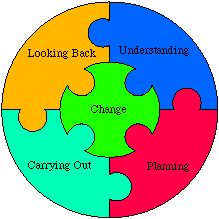
The first aspect to this model involves developing an understanding of the change that must occur. Questions to pose to shareholders that might stimulate thought and dialogue include 1.) Who and how, within the various contexts, might be affected by the changes being proposed? 2.) How are the culture, climate and beliefs of the schools or school system affected by the changes being proposed? 3.) How do these changes relate to personal and shared visions within the organization? 4.) What questions and needs do shareholders have regarding the change? 5.) Are the shareholders ready for the changes? 6.) Do the changes align with other initiatives? 7.) Which shareholders are the driving forces behind the changes? 8.) Who should be involved in the design team? 9.) What do the members of a design team need to know in order to build understanding? 10.) In what ways does greater understanding affect Creating a plan for change is the second component of this model. Questions to consider during this phase include 1.) What formats and approaches are used in the professional development design? 2.) Which formats and approaches need detailed examination? 3.) Which formats and approaches might enhance the strategic plan? 4.) How might these formats and approaches be integrated in an action plan? 5.) Is there an evaluation plan? 6.) Have the shareholders identified the criteria for evaluating the overall design and process. The next phase of this model involves carrying out the change plan and includes the following questions that shareholders should consider: 1.) How can an action plan be used to help manage the implementation of this change? 2.) How can an action plan be used for formative evaluation in various areas of the overall strategic plan? The last aspect of this framework involves evaluating and looking back at the effectiveness of the strategic plan for professional development; questions that might be considered during this phase include the following: 1.) How would the shareholders describe the effectiveness of the plan for improvement? 2.) How has this process assisted in the development of an effective professional development plan? 3.) How might the evaluation results further inform educational practice? 4.) How can the evaluation results be shared? 5.) How can the educational leaders support and maintain the focus and momentum of this plan?
NCRELS last model for effective professional development is The Concerns-Based Adoption Model (Hall & Loucks, 1979). The framework describes the seven levels of concern that educators experience as they implement new practices: 1.) Awareness- Teachers have little concern or involvement with the innovation. 2.) Informational- Teachers have a limited interest in the innovation and would like to know more about it. 3.) Personal- Teachers want to learn how the new practices will affect them. 4.) Management- Teachers learn the processes and tasks of the innovation; educators focus on information and resources. 5.) Consequence- Teachers are concerned with the impact the new practices will have on students. 6.) Collaboration- Teachers work with other educators to implement the new practices. 7.) Refocusing- Teachers consider the positive outcomes and add other skills to their repertoire that might also work effectively in the classroom.
Strategic Planning Models
There are many other models from both the worlds of education and business that merit discussion in this review and can aid educational leaders as they seek to define and structure their organizational visions to meet their emerging needs. These models apply to all areas of education. One of the first suggestions comes in the form of reframing the way one thinks concerning the planning for improvement in any area; this construct should be used as a verb rather than a noun. Organizations that plan for improvement are continuously undergoing transformation as needs emerge while keeping a focus on their vision.
Kaufman, Herman, and Watters (2002) divide strategic planning into three stages which are scoping, planning, and implementing the plan and continually improving. Each of these stages is divided into smaller segments.
Scoping is divided into three steps. These include defining the current mission, identifying and selecting needs, and deriving the mission objective. Defining the current mission involves looking to the future and defining that mission based on an ideal vision. The organization's mission should contain clear objectives that are measurable and focus on results. Without a vision-oriented mission, the strategic plan would not produce future oriented results. Assessing needs is divided this into nine steps. These include deciding to use data to assess needs, identifying the level of the needs assessment, identifying partners, getting the partners to participate, accepting the needs assessment frame of reference, collecting data, linking the needs into an assessment matrix, prioritizing the needs, and agreeing upon needs to be selected for inclusion in the strategic plan. The final phase in scoping is deriving the mission objective; it states four things which include who or what will demonstrate the performance, the performance to be demonstrated, the conditions under which the performance will be observed, and the criteria used to determine success.
The second stage of the Kaufman, Herman, and Watters strategic planning process is planning. There are three steps: 1.) identifying SWOTs, 2.) deriving long and short-term missions, and 3.) deriving a strategic plan. Identifying SWOTs involves defining the organization's strengths, weaknesses, opportunities, and threats. The next step in the planning stage is deriving short and long-term missions. Kaufman, Herman, and Watters (2002) wrote , each of these long and short-term missions should be (a) based upon the now shared ideal vision, needs, and existing mission, and (b) precisely identify where the educational organization is headed, and how everyone will know when (and if) they have arrived. Because measurable criteria are used, progress toward each of the missions and ideal may be plotted and reported toward continuous improvement. Appropriate responses, resources, and en route changes may be related. Deriving a strategic plan is the last step and involves an organization knowing where it wants to go and justifying why it wants to get there; the organization can then begin plotting the objectives required to get there.
The final stage in the Kaufman, Herman, and Watters strategic planning model is implementation and continuous improvement. These are broken down into deriving tactical and operational plans, implementation, continuous improvement/formative evaluation, and determining effectiveness ( Lorenzen, 2004). To gain critical success Kaufman, Herman, and Waters (1996) suggest shifting your paradigm to be larger and more inclusive by focusing on the mega level and thinking globally as you act, differentiating between the means and the ends, linking all levels of results, using an ideal vision as the underlying basis for planning, preparing mission objectives, and defining “need” as a gap in results.
Bryson (1995) offers a ten step strategic plan for organizational improvement: 1.) Initiate and agree upon a strategic planning process; 2 .) Identify organizational mandates; 3. ) Clarify organizational mission and values; 4. ) Assess the organization's external and internal environments to identify strengths, weaknesses, opportunities, and threats; 5 .) Identify the strategic issues facing the organization; 6. ) Formulate strategies to manage these issues; 7 .) Review and adopt the strategic plan or plans; 8 .) Establish an effective organizational vision ; 9 .) Develop an effective implementation process; and 10. ) Reassess strategies and the strategic planning process. It is important to note that a formative and summative assessment of the effectiveness of a strategic professional development plan are key to helping all shareholders reflect and adjust to gain the most beneficial results.
Wood's model involves five stages and focuses primarily on professional development, though many educational organizations have used this approach for improvement in other areas. The first stage is readiness and involves working in small groups to identify concerns, issues, and current practices. The second phase involves planning; the shareholders distinguish between goals, desired practices, and plan training activities. The next phase involves training all shareholders while allowing them to share, add, and critique the plan. Implementing the plan is the fourth phase and requires continuous support and resources for success. The final stage involves maintaining the plan for improvement; all shareholders should provide input to overcome obstacles and celebrate success. There is no phase to include evaluation in this model; without formative and summative evaluation of a plan, many organizations will continue on a path that may not result in positive change for all involved.
According to Holcomb (2001) Miles, Huberman, and Fullan provide a planning model that involves initiation, implementation, and institutionalization. This plan appears to be simple due to the lack of multiple steps; however, during each phase of the plan shareholders are involved and supported. The needs that are identified must be relevant to the shareholders; the organization must allocate the needed resources. When there is initiative taking, vision building, staff training, monitoring, and a continual adjusting for feedback, the plan will have a better chance to succeed. Sustaining the focus and momentum of the plan will not take place without an institutional commitment; this last important phase requires constant assistance with new practices and the removal of competing priorities (Holcomb, 2001).
The following phases that are presented by Holcomb (2001) allow the educational leader to follow a plan while asking the important questions along the journey of strategic planning and can apply to the realm of professional development as well as many other aspects of a high quality educational organization. Within each phase accompanying strategies will aid all shareholders who undertake the important task of improving educational practices which lead to student improvement.
Planning: Phase I
Where Are We Now?
Change is the law of life. And those who look only to the past and the present are
certain to miss the future. ~ John F. Kennedy
In order to improve or change an aspect of an organization, key shareholders must define their status as an organization and clearly define their current mission, vision, beliefs, and attitudes that are present at that time, taking into account the history, culture, and climate of the organization. Following this discussion and debate, it is necessary to find avenues to approach and discuss the themes that emerge from the participation of shareholders. Outcomes will emerge that should be included in the revised mission or vision and reflect the input of the participants that are taking their organization to meet the emerging goals the organization is aiming to achieve. Strategies that have been proposed to help facilitate meeting in this realm of discussion include:
- Think, Pair, Share
- Flowcharting
- Focus Groups
- Affinity Process
- Brainstorming
- Color Coding
- Fishbone (Cause and Effect)
- Force Field Analysis
- Venn Diagrams
- Talk Walk
- Reflective Study Groups
- Active Listening
Planning Phase: II
Where Do We Want To Go?
All our resolves and decisions are made in a mood or frame of mind which is certain to change. ~Marcel Proust
It can be difficult to bring groups to consensus on ideas involving educational missions and visions that involve change for improvement. Much skill in facilitating the process towards common goals is needed in this area of the journey. Educational leaders must compel the shareholders to openly discuss the question of “where do we want to go” and then carefully select among competing priorities. Leaders make selections based on priorities that have the greatest chance of producing change that lasts (Holcomb, 2001). Strategies to aid in this effort include:
- Affinity process
- Brainstorming
- Nominal Group Process
- Color Coding
- Weighted Voting
Planning Phase: III
How Will We Get There?
Ye can lead a man up to the university, but you can't make him think.
~Finley Peter Dunne
Answering this question requires the organization and its shareholders to be honest about why the organization is not functioning at the level they envision (Holcomb, 2001). It is important to study relevant research, investigate the practices in other schools and districts, further study the organization's practices, and examine local factors that may inhibit or aid in the success of the strategic plan. To aid educational leaders, the following strategies can help emphasize thoughtful analysis.
- Fishbone (Cause and Effect) Force Field Analysis
- Pie Charts
- Pareto Charts
- Graphic Organizers
- Decision Matrix
- Action Planning
Planning Phase: IV
How Will We Know We Are (Getting) There?
I was determined to know beans. ~Henry David Thoreau
There is no way to know that an organization is making progress unless there is a careful examination of practices. Are the shareholders following the plan? Is there data to indicate that the plan is being implemented? New practices cannot become a part of “how we do things around here” until it has moved from planning and training into consistent, skilled implementation (Holcomb, 2001). Educational leaders should look for strategies in this section to help them provide focus and motivation for the organization.
- Self Evaluation
- Surveys
Planning Phase: V
How Will We Sustain Momentum and Maintain Focus?
Pick battles big enough to matter, small enough to win. ~ Jonathon Kozol
The Northwest Regional Laboratory (1995) addressed the critical issues of leading and managing change and improvement; the publication discussed six important steps that effective leaders should follow in order to manage the process. Leaders should have 1.) A clear, strong, and collectively held vision and institutional mission, 2.) A strong, committed professional community within the school, 3.) Learning environments that promote high standards for student achievement, 4.) Sustained professional development to improve learning, 5.) Successful partnerships with parents, health and human service agencies, businesses, universities, and other community organizations, and 6.) A systemic planning and implementation process for instituting needed changes (NCREL, 1995). Dennis Sparks (1993), the Executive Director of the National Staff Development Council offered thirteen tips for managing the change process: 1.) E ducate the leaders, including both principals and teachers; 2.) Use a "systems" approach to ensure that all aspects of the school organization are considered when planning and implementing change; 3.) Use a team approach that involves many stakeholders; 4.) Share power with teachers and others; 5.) Make plans; however, be flexible; 6.) Develop plans and be flexible; leaders must realize that there can be tension between establishing readiness for change and the need to get people implementing new approaches; 7.) Provide considerable amounts of training and staff development; these activities can include everything from holding study groups to "on-the-dash" coaching; 8.) Choose innovative practices for and with teachers that are research-based and "classroom friendly"; 9.) Recognize that change happens only through people; 10.) Be prepared for the "implementation dip"; 11.) Help educators and others develop an understanding of the new practices; 12.) Seek out "paradigm shifters" and "idea champions" who are interested in making substantial changes in practice; and 13.) Take the long view; realize that change takes time and should not be forced to occur too quickly. In any situation that involves change, whether small or large, opposing sides will emerge. The drama that follows will involve protagonists and antagonists, pro and con positions, and all the other elements of conflict (Gerzon, 2006). Dedicate time and celebrate small wins. Other useful strategies to help educational leaders during this phase of the journey include the following:
• Coping with Conflict
• Venn Diagrams
• Quick Writes
• Talk Walks
• Go for the Green
Research Concerning Professional Development Programs in Education
Professional development generally refers to ongoing learning opportunities available to teachers, and other education personnel, through their schools and districts. Effective professional development is seen as increasingly vital to school success and teacher satisfaction. With schools today facing an array of complex challenges—from working with an increasingly diverse population of students, to integrating new technology in the classroom, to meeting rigorous academic standards and goals—observers have stressed the need for teachers to be able to enhance and build on their instructional knowledge (National Commission on Teaching & America's Future, 1996).
Professional development has traditionally been provided to teachers through school in-service workshops. The classic conception of that model, the district or school brings in an outside consultant or curriculum expert on a staff-development day to give teachers a one-time training seminar on a garden-variety pedagogic or subject-area topic. Such an approach has been routinely lamented in the professional literature. Experts variously say that it lacks continuity and coherence, that it misconceives of the way adults learn best, and that it fails to appreciate the complexity of teachers' work (Little, 1994; Miles, 1995).
Comparison of Two School Systems
In a limited sampling of two school systems' approach to professional development, I had the opportunity to discuss this important facet of educational reform with three individuals. The following represents a brief overview of discussions concerning the professional development programs offered in two school systems; they vary widely and can in no way be considered representative of all school systems.
After discussing the critical issues facing educational organizations concerning the construct of professional development there were a few themes that emerged; respondents felt that time, funding, and resistance to change impedes effective professional development (Harper, 2007; Quick, 2007). School systems must have instructional support specialists that aid educators in delivering research based instruction (Harper, 2007).
In the first school system there are three instructional support specialists and one instructional specialist coordinator. The focus of this position is to serve as a resource and support specialists to all teachers within the school system. Though this system is larger than the second system- six schools in the first and four schools in the second division; it is evident that a priority is placed on continuous learning and professional learning communities. “In our school system we have a model: I (the specialist) model the new practice, then we (the specialist and teacher implement the practice, and then, you (the teacher) individually implement the new practice (Harper, 2007). The “I do it, we do it, you do it” model has been implemented in Harper's school system and as the coordinator of instructional specialists; she sees this as being valuable to both novice and master teachers (Harper, 2007). Teachers that attend professional development training are required to return to the organization, attend a follow up meeting, and provide lesson plans that implement new practices. After implementing the lesson plans the teachers return for a second time to discuss the positive and negative outcomes of implementing the new practice(s). According to Harper (2007), this approach has reduced teacher attrition rates and increased student performance. Harper notes that funding is difficult at times along with occasional resistance to follow up activities; however, recertification points hinge on this important aspect of professional development
The other school system continues to implement professional development with one day work shops, three to five hour “sit and get sessions, and only provides this training three times a year: beginning, middle, and end (Quick, 2007). There is little follow up and no model in place to evaluate the effectiveness of training and the transference of learning into the classroom. Capacity within the system is not built as often as necessary due to conference attendees not being required to present and share new found knowledge. Despite research on reflection and follow up, there has been little change in the delivery of training to teachers (Quick, 2007). The school system faces high teacher attrition rates and low morale at times due to lack of continuity and a model of a professional development program that encompasses both formative and summative evaluation (Quick, 2007, Carpenter, 2007). The necessity is there to change the way professional development is delivered; however, Quick (2007) sees time, funding, and resistance from within the organization as impeding progress.
It is difficult to draw patterns or make inferences due to the lack of samples in this section. It is merely an attempt to begin to better understand the differing practices that take place in educational organizations. To gain better knowledge and draw strong conclusions concerning effective professional development it is necessary to discuss and sample many school systems across the United States . The limited responses in this text in no way represent the vast majority of schools that are working effortlessly to improve teacher and student learning.
There are many sources and strategies from leading theorists in the field of educational improvement; these authors keenly understand the current atmosphere of accountability that can cause polarization in the educational community, the sources within this text reflect positive solutions to the nonlinear change that occurs daily. This resource list is not exhaustive in nature; this is merely an attempt to aid educational administrators in the planning process. Please visit the following Web site for more information http://www.topicsineducation.com, provide feedback, and suggest other resources to add to the list; it is our responsibility to contribute to the community of learning.