

















Presented By:
Jamie Carpenter
Greg Hutchings
Bronwyn MacFarlane
Holly Richard
Power Point
Presentation On Gender in Education
Travis Burns
Antoine Hickman
Patricia Kern
Shelly Nowacek
Power Point
Presentation On Special Education
Webmaster:
Jamie Carpenter

Gender Issues in Education
The Emergence of Gender Issues in American Education
Until this century, gender issues would not have been an issue due to the relatively recent practice of allowing females to pursue the same educational opportunities as males in the United States . Historically, girls had less formal education than boys and it was not until the beginning of the 20 th century that it became acceptable for women to receive some form of higher education (Boumil et al, 1994, p. 172). This coincided with the civil rights movement beginning in the 1950's and the historic Brown v. Board of Education decision, ending the “separate but equal” doctrine established in Plessy v. Ferguson .
While the “separate but equal” policy had been overturned for racial discrimination, however, gender discrimination was still very much a part of the American educational system (Boumil et al, 1994, p. 175). One of the earliest challenges to single-sex higher education arose in Heaton v. Bristol , in which two female plaintiffs sought admission to the Agricultural and Mechanical College of Texas (Texas A & M) because the women's colleges were too far 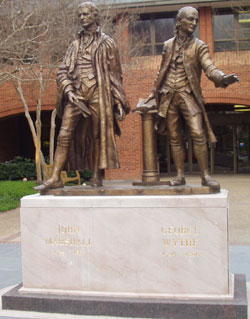 away. When they were denied admission, the court granted mandamus compelling the womens' admission to the school (Boumil et al, 1994, p. 173).
Key legislation leading to policy changes toward equal educational opportunity for women and prohibition of sexual discrimination included the following:
• Civil Rights Act of 1964
• Title VI: prohibiting racial discrimination
Gender in Education
• Title VII: prohibiting sexual discrimination
• Higher Education Act
• Title IX (1972): prohibiting gender discrimination in education; providing access to higher education and to athletic opportunities for women
• 1975: First set of proposed amendments to Title IX (Boumil et al, 1994, pp. 181 – 184).
The enactment of Title IX of the Education Amendments of 1972 had a significant impact on women's access to higher education. This broad ban on sex discrimination was patterned after the Civil Rights Act prohibiting racial discrimination and impacted all institutions receiving federal aid (Boumil et al, 1994, p. 184) and states that:
No person in the United States shall, on the basis of sex, be excluded from participation in, be denied the benefits of, or be subjected to discrimination under any education program or activity receiving Federal financial assistance.
The ruling included public institutions of higher education, vocational and professional education, but excluded institutions controlled by religious organizations, those training for military service, and those that had admitted students of only one sex from their establishment (Boumil et al, 1994, p. 179).
Read the Complete Paper on Gender Issues
Doctoral students researched and produced the information contained within this Web site; it is not inclusive of all available data. This project is a culmination of Dr. James Stronge's Seminar of Legal Issues in Education course at The College of William and Mary, Williamsburg , Virginia. This site is for educational purposes only.